No-Show Guest: How to Handle It Properly
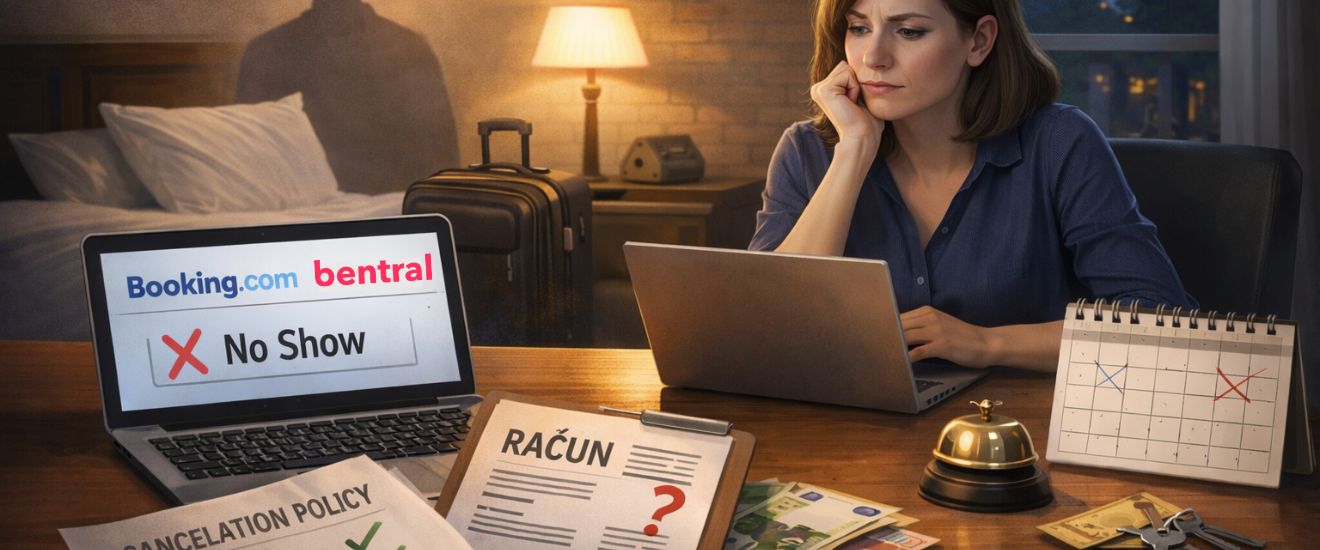
Sooner or later, every host encounters a situation where a guest has a confirmed reservation—often already paid for—but simply does not arrive on the day of check-in. This situation is commonly called a no-show. When this happens, several questions usually come up: Do I still need to issue an invoice? Should I register the guest in eTurizem? What about the tourist tax and VAT? Let’s look at the correct way to handle this situation.
When the Guest Doesn’t Arrive: Mark the Reservation as No-Show
If you realize that the guest did not arrive on the day of check-in, the first step is to mark the reservation as a no-show. If you are using the Bentral channel manager, simply mark the reservation as NO-SHOW. This will automatically:
- release the reservation from the calendar,
- ensure the system does not count it as a completed stay,
- and no corrections are needed in your guest registration records, since the reservation will not be counted as a completed stay.
What if the reservation came through Booking?
If the reservation was made through Booking.com and you do not use a channel manager, you also need to mark the reservation as a no-show in the Booking extranet.
In the reservation details, select “Mark as no-show.” The system will then ask whether you would like to refund the reservation amount to the guest.
You will see the same question if you mark the reservation as a no-show in Bentral. In most cases, you do not need to refund the payment, because your cancellation policy will apply.
For example, if your policy allows free cancellation up to 1 day before arrival, and the guest neither cancels in time nor arrives, the reservation is treated as a late cancellation or no-show. In this case, you are entitled to keep the full reservation amount.
Of course, hosts can always decide otherwise. If you prefer to be more flexible—for example due to exceptional circumstances or good communication with the guest—you may partially or fully refund the amount, even though you are not obligated to do so under the booking conditions.
Do You Still Need to Issue an Invoice?
The short answer is: yes, you still need to issue an invoice.
Even though the guest did not arrive, the accommodation unit was reserved and blocked exclusively for that guest. In most cases, the reservation was not canceled within the allowed cancellation period, so the host keeps the payment according to the booking conditions.
However, the invoice should reflect a few important specifics:
- no tourist tax is charged, because the guest did not stay overnight
- no cleaning fee is charged, if it is normally listed separately
- VAT is not charged, if you are a VAT-registered business and you are renting in Slovenia.
The invoice should also include the following clause (applicable for businesses operating in Slovenia): “VAT is not charged in accordance with Article 13 of PZDDV-NPB14.” If you operate in another country, check the local VAT rules, as the tax treatment of no-show reservations may differ.
Why Is VAT Not Charged?
The key question in no-show situations is whether the service was actually provided. In this case, the accommodation service was not delivered, since the guest never used the property. The payment that the host retains is therefore not considered payment for a service, but rather compensation for cancellation or non-arrival.
According to the rules implementing the VAT Act, such compensation is not subject to VAT, which is why VAT is not charged on the invoice. This is also the reason why the appropriate explanatory clause should be included on the invoice.
Quick Summary for Hosts
If a guest does not arrive for a confirmed reservation:
- mark the reservation as NO-SHOW,
- do not register the guest in eTurizem,
- still issue an invoice,
- the invoice does not include tourist tax, cleaning, or VAT,
- add the VAT exemption clause.
Conclusion
No-show situations are a normal part of running an accommodation business, and almost every host encounters them at some point. The most important thing is to handle the process correctly—both administratively and from a tax perspective. Once you understand the rules, the procedure is quite simple: mark the reservation as a no-show, do not register the guest, and issue an invoice as compensation for the unused reservation. This keeps your records accurate and your business compliant with the applicable regulations.